My next middle-grade story is officially underway.
Lauren George of @nouveaucrtv has already created the cover for it, and I am absolutely obsessed! I can’t wait to share it. Stay tuned for more updates.
If your book is sitting on your bedside table staring at you with a list of questions like “Where have you been? And why hasn’t this bookmark moved?” I get it.
Maybe you haven’t picked up a book in a while. Maybe you started a new one without finishing the old one. That’s ok.
This doesn’t mean you are failing. Sometimes life feels heavy. Sometimes life gets busy, and that weight changes how we read.
Maybe your mind keeps wandering back to today’s responsibilities. Maybe you fall asleep two pages in. Maybe the quiet that reading requires feels harder to find than it used to. That doesn’t mean stories stopped being for you. It might just mean that you’re carrying more than you once did.
When Reading Used to Feel Like Home
There was probably a time when stories felt fun, like home— a place you could enjoy and linger often.
If they feel far away now, it’s not because your imagination packed its bags and left the building. It hasn’t been taken prisoner and locked away in some far-off tower, never to be seen again.
When life is full—emotionally, mentally, and spiritually—it is harder for your brain to go into wandering mode.
Reading asks for:
Stillness
Attention
Focus
And when you’re tired, those things are harder. So if you’ve been skimming, rereading the same page, or quietly closing the book altogether, it’s just a signal.
A signal that you might need gentler stories, or shorter chapters, or permission to read differently for a while.
When Imagination Goes Quiet
Imagination doesn’t disappear when the storms of life rain down around us—it curls up. Maybe it pauses by the window pane and watches the water droplets slide down the glass waiting for the sun to come out again.
Cozy stories are worth reading because they ignite our imaginations and help us understand the world. C.S. Lewis encourages us: “This is what the imagination is about: not just the ability to dream up fanciful fables, but the ability to identify meaning, to know when we have come upon something truly meaningful.”
A Gentle Invitation
If you want to try reading again—not because you should, but because you miss it—here’s a simple way back:
Welcome to Green Haven—a town that looks like a postcard but hides stories beneath its charming surface.
Nestled between lakes and lush forests, Green Haven is a place where the scent of freshly baked bread drifts from the local bakery, children chase fireflies at dusk, and neighbors greet each other with warm smiles. It’s the kind of town where everyone knows everyone—until a whisper of scandal makes them wonder how much they truly know.
But beneath the quaint storefronts and tidy gardens, secrets grow like weeds. Locked doors hide quiet grudges, and familiar faces can suddenly seem like strangers. It’s a place where the gossip travels faster than the river current, and a friendly smile might conceal a hidden agenda.
For those who look closely—like Amelia B. Jones, the town’s tenacious reporter—Green Haven is more than a picturesque haven. It’s a puzzle waiting to be solved, a story waiting to be uncovered.
Welcome to Green Haven. Stay long enough, and you might just discover that not everything is as it seems.
Join my cozy community and get exclusive updates, giveaways, and sneak peeks straight to your inbox! Subscribe now.
I’m thrilled to finally share the cover of my upcoming cozy mystery novel!
Introducing: Amelia B. Jones & The Lost Lady
The testimony of a cat won’t stand in a court of law. But that’s never stopped Winston P. Finnegan from speaking his mind.
In the quiet town of Green Haven, sunshine and civility mask something darker. When reporter Amelia B. Jones discovers her colleague Tom Holt dead under suspicious circumstances, her gut insists it wasn’t just a tragic accident—it was something far more sinister.
Amelia, with her literal mind and awkward social footing, is used to being overlooked. But she sees what others miss: a twitch in a smile, a silence too long, a detail no one else thinks matters. With Winston—her sarcastic, sharp-eyed Siamese cat—at her side, she follows a trail of clues through locked doors, whispered warnings, and the shadows of Green Haven’s polished facades.
But truth comes at a cost. As the danger creeps closer, Amelia must decide how much she’s willing to risk to bring it into the light—because in Green Haven, secrets don’t stay buried without a fight.
I don’t remember much about the day I was born (which, let’s be real, is a bit of a missed opportunity for a memoir), but from what I’ve heard, I definitely made an entrance. Not only did I manage to tie a knot in my umbilical cord (you’re welcome, Mom), but apparently, the highlight of the day was my Oscar-worthy performance: I cried.
Now, I’m told that’s what babies do, but I’ve got to wonder—was I wailing because of the Thunder Thighs nickname I was allegedly gifted with on Day One? Or was it more about the fact that I arrived in a world that was still obsessed with neon colors, oversized jackets, high-waisted jeans, scrunchies, and hairspray that could survive a hurricane?
Now, let’s be honest: I’ll never know if I was crying from the chaos of entering the world or if I was just gasping for air because I was that overwhelmed by the sheer wonder of it all. But given that I entered the world in 1987, I’m pretty sure I was also just Livin’ on a Prayer, right alongside Bon Jovi, who was tearing up the charts with that classic anthem.
I made my grand debut in Phoenix, Arizona—the land of cacti, heat, and very, very confused fashion choices. (Seriously, who thought it was a good idea to cut our hair in the shape of a triangle?) Anyway, I was two days late. Two! I like to think I was just savoring my moment, letting the world know that nobody was going to rush this Queen Bee into existence.
Fun fact: it was chilly that day—chilly in Arizona! People actually wore coats. I wasn’t about to freeze, but someone might want to let Arizona know that “coats” aren’t usually in the daily wardrobe rotation.
Now, let’s talk about my dad. This man showed up to the hospital in a suit. And not because he’s some fancy businessman who lives in suits—oh no. He’d just preached that morning at his college and figured, “Why not? I’ve got a suit, might as well wear it to meet my kid.” I was clearly not in a rush (again, two days late), so he showed up in style, looking like he was ready to close a deal.
And then there was my mom—bless her heart—who was dealing with a whole other level of drama. Apparently, she went full-on “hide on the hospital roof” mode, convinced they’d send her home with the classic “Nope, not in labor, try again later!” She was not about to face that kind of heartbreak. So, there she was, literally on the hospital roof (probably wishing she had a scrunchie to tie her hair), while my granny tried to convince her to come inside.
I’ll spare you the drama: she came inside. While my mom was in the middle of labor with me, my twenty-two-month-old brother decided it was the perfect time to play, “Extreme Makeover: Hospital Room Edition.” As my mom was busy doing, you know, the most important thing ever (bringing me into the world), he was wheeling around all the random hospital equipment like he was their personal moving company. He’d grab a pile of towels, toss them to a corner, and then yank out a tray of medical supplies as if he was redecorating the maternity ward. The midwives just let him do his thing—and even told my mom he could stay for the birth. But she got my dad on the phone and asked for his parents to come as reinforcements. Afterward, my dad, in panic mode, packed five slips for my mom. Yes, five.
Five. Slips. For a woman about to give birth. Spoiler alert: she didn’t need a single one.
As my mom winced in pain, my dad– who had just arrived, bouncing off the walls with excitement, eagerly asked, “Is that a contraction?” But my mom, not missing a beat, deadpanned, “No, you just ran over my toe with that doctor’s chair!”
Anyway, when I finally made my grand entrance at 9:02 PM, there was a brief moment of pure confusion. My dad, practically glowing with pride, shouted, “It’s a girl!” My mom, who had hoped and prayed for a girl more than anything, stared at him, bewildered, and said, “I don’t know what that means.” She had literally convinced herself that a girl wasn’t even an option, but surprise—there I was, all 6 pounds and 15 ounces of pure, unfiltered chaos.
As for my name, my parents decided on Ashley Ruth, a name that felt perfectly 80s and, more importantly, tied me to two amazing women in our family. I hope I live up to the meaning of Ruth—loyal, kind, and compassionate. Although full disclosure, I’ve been known to be a bit of a Queen bee at times.So, here I am, years later, still trying to make sense of that day. Was it the power of Bon Jovi’s Livin’ on a Prayer, the high-waisted jeans, or just the joy of knowing my mom didn’t have to wear five slips that finally got her into the hospital? We’ll never know. But whatever the reason, I made my grand entrance—and the first thing I did was cry. And probably scream something about needing a snack. That’s how it all started for me.
p.s. Here is the front page of The New York Times from the day I was born.
The sacred practice of lament serves as a bridge between life’s trials and the hope found in Christ. By bringing our discontentment before God in prayer, we have the opportunity to transform our pain into praise and uncover the profound mystery of true contentment—a contentment not defined by our circumstances, but by Christ alone.
When the rains of suffering pour down and the storms of sin rage around us, where can we find shelter? For believers facing these turbulent times, the challenge is to remain anchored—to resist the powerful currents of anxiety and discontent. The Puritan wisdom, “There is nothing that can befall us without Him in whom we live,” stands as a guiding light, leading us toward lasting peace and true contentment.
Now, let’s explore some practical steps to help cultivate a heart of contentment amid life’s challenges.
1. Embrace Emotion
First and foremost, we must reject a stoic approach to life. While Stoicism emphasizes a detached form of contentment, Christianity invites us to experience a full spectrum of emotions—including lament. As theologian Gregg Allison reminds us, “Maturing as Christ’s followers is not only about spiritual and moral/ethical progress but physical development as well.” God designed us as holistic beings, and true contentment comes from acknowledging and nurturing our emotional and physical well-being.
Engaging in life’s activities—sleeping well, fulfilling our God-given responsibilities, praying, crying, celebrating, exercising, and enjoying meals—are all essential components of being content. Lament, far from being a weakness, is a powerful gift that connects us to our embodied reality and the grace of God.
2. From Pain to Praise: The Mystery of Transformation
Next, we can observe how God transforms pain into praise. The journey of lament often leads us to profound revelations about our circumstances. As Burroughs wisely states, “The way of contentment to a carnal heart is only the removing of the affliction. O that it may be gone! ‘No,’ says a gracious heart, ‘God has taught me a way to be content though the affliction itself still continues.’”
Consider the metamorphosis of a butterfly: from an egg to a caterpillar, then to a chrysalis, and finally emerging as a beautiful butterfly. This process reflects how God can take our trials and transform them into something magnificent. The story of Joseph in the Bible illustrates this perfectly—despite his brothers’ betrayal, he recognized God’s hand at work: “You meant evil against me, but God meant it for good” (Genesis 50:20).
Through Jesus’ own suffering, we see the ultimate example of how God can turn darkness into light. If He can bring good from the most harrowing of circumstances, surely He can do the same in our lives. Burroughs emphasizes this mystery of contentment, where affliction is not merely removed but transformed into something beneficial.
3. The Art of Subtraction: Finding Contentment in Less
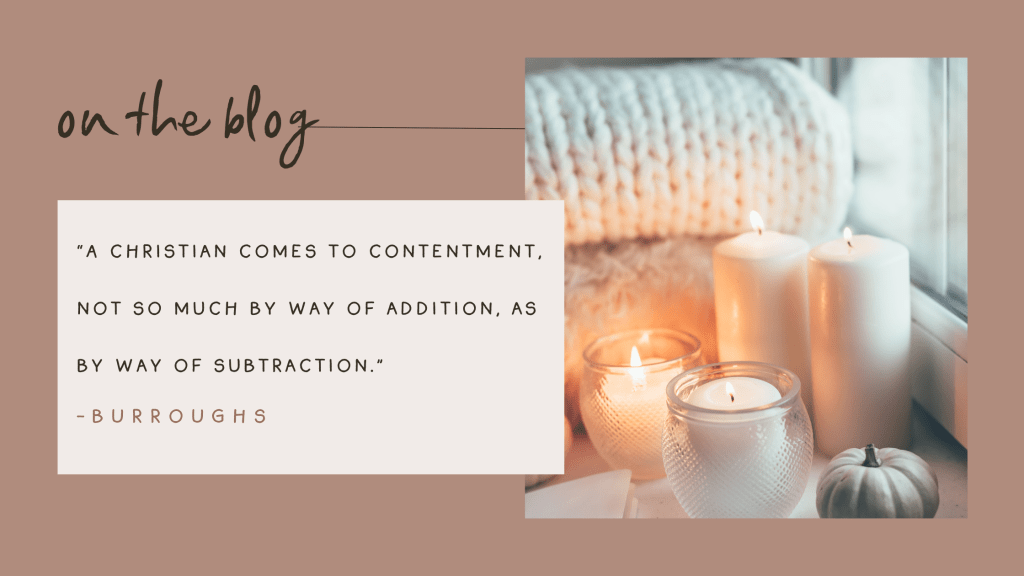
A practical approach to achieving contentment involves understanding the concept of addition and subtraction. In a world obsessed with accumulating more—be it wealth, status, or relationships—we must remember that true contentment often comes from subtracting our desires rather than adding to our lives. Burroughs asserts, “A Christian comes to contentment, not so much by way of addition, as by way of subtraction.”
Instead of seeking to fulfill every desire, we should strive for an “evenness” between our hearts and our circumstances. This shift in perspective allows us to find peace in our current situations rather than constantly yearning for more. It helps us to find peace where we are, rather than constantly longing for what we lack.
4. If You Must Add, Add Eternity
If you find yourself wanting to add something to your life, let it be the weighty matter of your relationship with the Creator. Burroughs encourages us to carry the burden of our sins and seek peace with God above all else. “When the heart is taken up with the weighty things of eternity,” he says, “the things of here below that disquieted it before are of no consequence.”
This focus on eternal matters helps diminish the significance of temporary struggles, guiding us toward a deeper, more fulfilling sense of contentment.
5. Gratitude: Enjoying God’s Gifts
Finally, remember to enjoy the blessings you already possess. Whether it’s health, family, a job, or simple pleasures, gratitude opens our hearts to the beauty of God’s grace. Burroughs beautifully states, “So by the art of contentment, we may bring in the comfort of any condition to ourselves.” Accepting and cherishing God’s gifts allows us to cultivate a joyful spirit.
Conclusion: The Sacred Art of Contentment
While both believers and non-believers value contentment, the Christian understanding of it differs profoundly from Stoic philosophy. For Christians, the path to contentment involves embracing Christ and allowing the practice of lament to enrich our emotional lives.
The teachings of Puritan thinkers like Burroughs, Boston, and Flavel reveal that true contentment is born from a deep relationship with God and an understanding of His providence. In a world filled with turmoil, let us find peace in knowing that God’s grace can quiet our restless hearts.
In the end, “Lighten your heart by laying your all upon Him.” Embrace the journey toward contentment, recognizing that it is a sacred art, woven into the fabric of our faith and experience.
In a world filled with turmoil and sorrow, Jesus illustrates that lament is essential for attaining true contentment. It is easy to overlook the profound emotions that content individuals experience. But look at Jesus. The most content man to have ever lived exemplified a full range of human emotions throughout his life.
Contentment in the Midst of Temptation
In the midst of temptation, contentment is possible. During a wilderness experience Jesus earned our righteousness and provided us with a beautiful example. In the face of temptation, Jesus remained steadfastly content with his Father’s plan. During his time in the wilderness, Satan tempted him three times, trying to sow seeds of discontent (Luke 4:1-13). Yet, Jesus turned away from the allure of instant gratification, worldly power, and self-interest.
In his most anguished moments, such as in the Garden of Gethsemane, he lamented profoundly: “My soul is very sorrowful, even to death” (Matthew 26:38a). Still, he submitted to the Father’s will, praying, “yet not what I will, but what you will” (Mark 14:36).
These moments of lament show us that Jesus did not shy away from expressing sorrow and suffering during temptation. Instead, he embraced them, modeling a life where lament and contentment coexist. In doing so, he teaches us that lament is not merely an expression of grief; it is a vital part of our spiritual journey. It allows us to release the tension that comes from living in a broken world while still striving for Christlike contentment.
Contentment in the Midst of Pain
One of the most poignant moments in the Gospels, when we see Jesus lament, is when he wept at the graveside of his friend Lazarus (John 11:35). In the face of a personal tragedy, he allowed himself to feel. His friend died and he cried. However, this act of sorrow was not an isolated incident. In Luke 19:41-42, we see another instance of Jesus’s lament as he approaches Jerusalem. Here, he weeps over the city, expressing a deep longing for its people to recognize the path to peace: “Would that you, even you, had known on this day the things that make for peace! But now they are hidden from your eyes.” This sorrow reflects Jesus’s deep concern for those who are lost and estranged from God.
The emotions he displayed throughout Luke 19 serve as a powerful reminder of his humanity. The chapter begins with his triumphant entry into Jerusalem. The moment is filled with joy and hope, yet quickly shifts to a moment of deep lament over the city. Right after this, Jesus cleanses the temple, exhibiting righteous anger over sin. This sequence of 1) weeping over a city, 2) entering triumphantly, 3) dealing with sin, and 4) making a way for men to be brought near to God paints a beautiful picture of a fully embodied, emotional, and righteous Savior. By feeling, thinking, and acting perfectly, Jesus paved the way for us to find true contentment.
Ultimately, the life of Jesus illustrates that lament is an essential part of attaining true contentment. Lament invites us to acknowledge our struggles and pain while still holding on to hope and faith. In embracing our own moments of lament, we too can find peace and a deeper understanding of God’s plan for our lives. So, let us not shy away from a full range of emotions, but rather embrace it as a path toward greater contentment and connection with God.
“There lies the first mystery of contentment. A truly contented man, though he is the most contented man in the world, is the most dissatisfied man in the world: that is, those things that will satisfy the world will not satisfy him.” –Jeremiah Burroughs
There is a paradox to contentment. And it causes us to wrestle. What makes a Christian content? What are we supposed to do when we’re unsatisfied?
Recently, many have turned to Stoicism for the answer. A quick search shows more than a handful of books retrieving Stoic principles for our day: The Daily Stoic, How to Be a Stoic, The Stoic Challenge, and The Practicing Stoic are just a few titles on the list. Stoicism promotes inner peace and emotional resilience by regulating emotions through rationality. Basically, if it’s outside of your control, you shouldn’t feel bad about it.
It can be easy to see why Stoicism has gained momentum in this frenetic cultural moment: there’s some truth to it. But the Bible offers a deeper source of contentment that embodies a fuller range of emotions. Even when things are out of your control, there are things we should feel. This practice is called lament.
Discontentment Finds a Voice in Lament
We can learn contentment through the art of lament. Are believers meant to be quiet, calm, and collected in the face of challenging circumstances? I believe the Bible presses beyond this outward expression of Stoicism. After all this could be hypocrisy if one’s internal state differs from an outward, quiet demeanor. Remember Jesus’s words in Matthew 23:27-28, “Woe to you, teachers of the law and Pharisees, you hypocrites! You are like whitewashed tombs, which look beautiful on the outside but on the inside are full of the bones of the dead and everything unclean. In the same way, on the outside, you appear to people as righteous, but on the inside, you are full of hypocrisy and wickedness.” Biblical contentment moves beyond the outward appearance and gives voice to the internal discontentment with the world, the flesh, and the devil.
Lament is the cry of God’s children to their Father in a fallen world. The Dictionary of Biblical Imagery explains, “Common occasions for lament psalms are mockery or slander by personal enemies, warfare, disease, drought or the burden of sin and guilt.” Though these things are mostly outside our control, the believer has a place to complain. He is welcome to talk to his Father. Christian author Mark Vroegop says, “Lament is how you live between the poles of a hard life and trust in God’s sovereignty.” When a situation looks hopeless, the believer comes to the all-sufficient God. Lament is the believer’s way to grieve and pray. Vroegop continues, “Lament is rooted in what we believe. It is a prayer loaded with theology.” It is how pain is gloriously transformed into praise. Lament asks real questions like “(1) ‘Where are you, God?’ (2) ‘If you love me, why is this happening?’” Lament is the place for discontentment and vexation to find a voice. Vroegop describes lament as turning to God in prayer (Psalm 77), “Bring your complaints” to God (Psalm 10), “Asking boldly” (Psalm 22), and choosing to trust (Psalm 13). Because believers live in a fallen world, we must learn contentment. Lament is the key that unlocks the door to contentment.
There is a paradox to contentment. Christians aren’t satisfied with the world, the flesh, or what the devil has to offer. We turn to Christ as our great gain, and we learn through our experiences. We find that we aren’t alone in our suffering. God our Father, is a very present help in time of trouble and his ear is open to our cries.
Contentment is Learned
If the practice of lament feels foreign to you, there’s good news. Contentment can be learned over time. As the Apostle Paul says, “Not that I am speaking of being in need, for I have learned in whatever situation I am to be content” (Philippians 4:11). The mystery of contentment is that believers gain contentment as they rely on the all-sufficient God. This means godly people like Paul had to wrestle to come “to grips with his circumstances.” He did so by relying on his relationship with Christ. These real-life circumstances are actually teaching him how to have “an attitude of appreciation, contentment, adaptability, and dependency.”
Even Stoic philosophers say, “The wise person will develop virtues” whether “in riches” or “in poverty” “in his own country” or “in exile,” “as commander” or “as a soldier,” “healthy” or “sickly.” But it is significant to notice that in the face of difficult circumstances, Paul moves beyond a merely Stoic outward demeanor. Paul learned to be content with his lot, not only externally but also internally.
The Bible lays the groundwork for this kind of contentment in hard times. Christian contentment is a life weaned from the world and is “in need of no support” outside of Christ. Yes, a content Christian can enjoy God’s good gifts on earth but is not reliant on them.
Contentment is Great Gain
Finally, contentment is great gain. First Timothy 6:6-7 says, “But godliness with contentment is great gain. For we brought nothing into the world, and we cannot take anything out of the world.” Contentment is the overflow of wisdom and is a great treasure. It is a way to flourish in life. And it is the only way the well-loved hymn writer Horatio Spafford could pen after losing most of his children, “And whatever my lot / Thou has taught me to say / It is well, it is well with my soul.” This kind of soul-lament is not Stoic. It is deeply Christian. And may we likewise lean into this kind of lament-fueled contentment.
Sources
Jeremiah Burroughs, The Rare Jewel of Christian Contentment 19, 27.
Melick Philippians, Colossians, Philemon 154-155.
Vroegop, Dark Clouds, Deep Mercy 9, 21, 26,28
Hellerman, Philippians 258.
Ryken, Wilhoit, and Longman, Dictionary of Biblical Imagery 484.
I am enjoying the New Growth Press series “Ask The Christian Counselor.” It is packed with practical, comforting, and gentle encouragement. This week’s book is “Anxious About Decisions” by Michael Gembola. Gembola helps us understand what decision anxiety is and how it works. He explores the way people try to fix it and oftentimes fail. Then he addresses the topic of God’s will and how our decisions play into that. Once we grasp the problem, he narrows anxiety down into different topics like: moving into adulthood, family, marriage, vocation, as well as plans and purchases. I love when Gembola said, “In all of our decision making, the Holy Spirit never leaves or forsakes us.” We can be encouraged because we are never alone in making decisions. God is with us. Whether you struggle with decision anxiety or have a friend who does, I believe this will be book encouraging to you.
I love the goal of the book “God Made Babies.” While many caregivers can feel perplexed about how to answer, the “where do babies come from? question. Justin and Lindsey Holcomb wrote this book to help equip caregivers to have this conversation. This book draws from creation and looks at the reproduction system seen throughout God’s world. It highlights God’s goodness. This book has fun illustrations, biblically based truth for kids to think through, as well as a way to help caregivers.
That said, this book had more words than I thought it would, so I’d say it is for older kids like 4–8 years old. It would be a little over my three-year olds head.
As a parent, I know and you know this question is coming. I’d recommend caregivers have age appropriate answers ready, and I think this book will help equip parents to continue to talk to their kids.
























 Ashley Baker